
In the spring of 1884, a young American painter hung a canvas at the Paris Salon that most of the city had been waiting to see. The subject was a woman everyone recognised. Virginie Amélie Avegno Gautreau, born in New Orleans in 1859, married to a wealthy French banker, was one of the most photographed and least photographed women in Paris. People knew her face. They did not know much else. Sargent had spent more than a year trying to paint her, writing to friends that he could not find a pose that made her look the way she looked in a room.
What he finally hung was a standing figure, more than two metres tall, in a black velvet gown and a diamond-tipped strap, against an empty brown background. It was called Portrait de Mme *** in the catalogue — a discreet anonymity that fooled nobody. By the time the Salon opened, the painting was the scandal of the season, and the scandal had almost nothing to do with the woman. It had to do with a shoulder strap.
The Woman and the Pose
Madame Gautreau had what the Parisian press of the 1880s called a beauté de premier choix, a first-choice beauty, meaning that her looks were almost too singular to be conventional. Her skin was pale to the point of lavender, achieved partly by nature, partly by a dusting of rice powder and a touch of blue pigment that gave her a marble quality. She was not a professional sitter. She had no interest in modelling for painters, and Sargent was not her first choice. He courted her for months. His friend Madame Gautreau wrote that he was, in his own words, "mad about this woman."
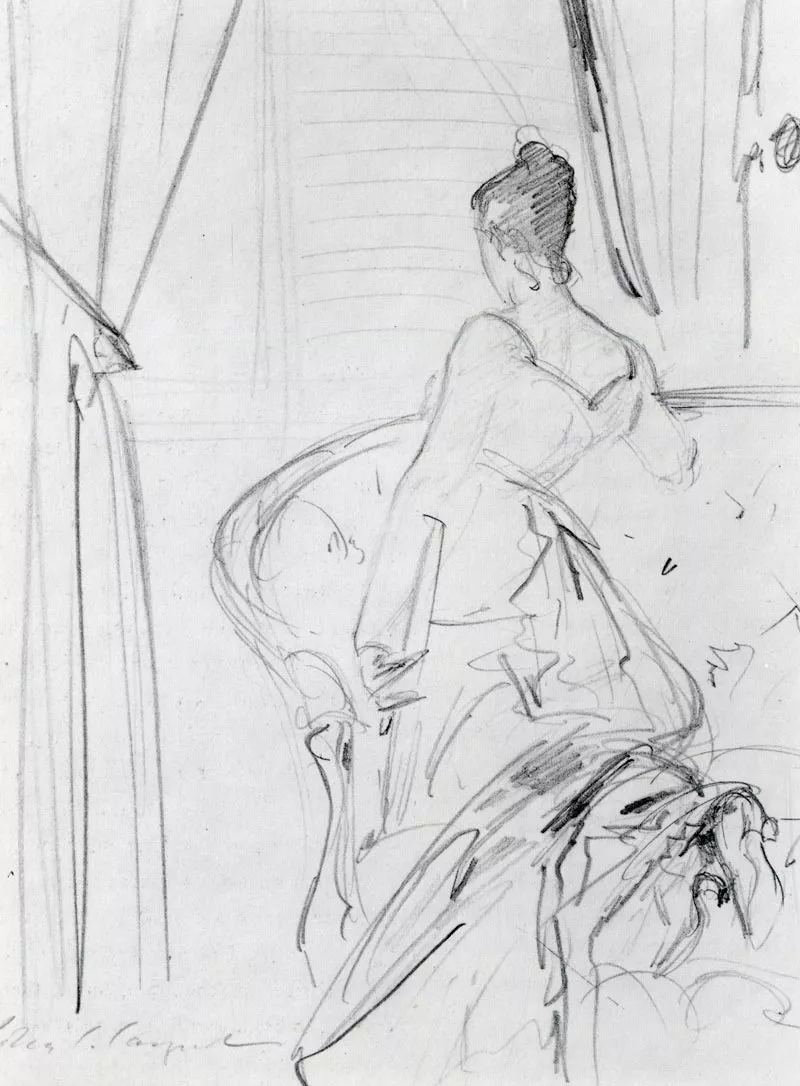 Sargent made dozens of sketches before settling on the final pose. In this study, the head is still turned differently from the finished canvas.
The pose he settled on is unusual for the period. Madame Gautreau stands, but her weight rests on one leg, and her head turns sharply to the left, away from the viewer. Her right hand reaches back to the arm of an unseen chair, or perhaps the edge of a table. The skin above her dress is the subject of the painting. The arm, the throat, the ear, the right shoulder — Sargent painted them with a thin, almost translucent touch, no visible brushstrokes, no modelling, just pale colour on top of pale colour.
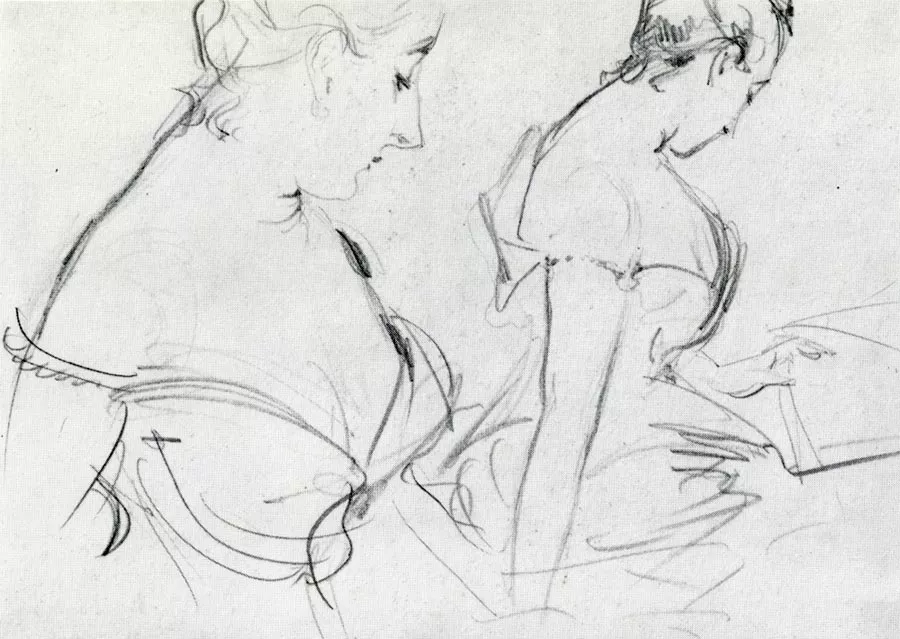 He tested multiple poses. The final choice, with the body turned away and the head in sharp profile, was one of many attempts.
The Strap, On and Off
The original canvas at the Salon showed the right shoulder strap falling. Not slipped — falling, mid-motion, the kind of detail a painter includes only when he wants the viewer to notice that it is about to come down. Contemporary accounts disagree on how far the strap had dropped. Some witnesses described it hanging loose against the arm. Others reported it had already fallen past the shoulder, revealing more skin than the censors of 1884 were prepared to accept. The Salon jury accepted the painting. The public did not.
The reaction was savage. Newspapers published caricatures. A critic in Le Figaro called the pose obscene. Sargent's friend Edward Simmons wrote that the painting looked like a "stray French gal" who had been caught mid-dressing. More damaging, the family of Madame Gautreau was humiliated. Her mother is said to have begged Sargent to withdraw the painting. He refused. He did, however, do something he would not have done for anyone else. He repainted the strap back onto the shoulder.
The painting you see today at the Metropolitan Museum of Art is not the painting that hung at the Salon. The version in the Met has the strap firmly on the shoulder. The scandal version exists only in caricatures, in witness accounts, and in a single photograph that Sargent himself is said to have regretted. He took the painting back to his studio, where it stayed for thirty-two years. He did not exhibit it again. He did not sell it until 1916, when the Met offered to buy it, and he accepted on the condition that the museum keep it off display for at least a year.
.png "Sargent, Madame X") What hangs in the Met today is not what hung in 1884. Sargent pulled the strap back onto the shoulder within months of the Salon and the original exists only in secondhand accounts
What hangs in the Met today is not what hung in 1884. Sargent pulled the strap back onto the shoulder within months of the Salon and the original exists only in secondhand accountsThe Skin That Wasn't Real
What made the painting scandalous was not the strap alone. It was the combination of the strap with the pallor. Sargent had painted Madame Gautreau's skin in a range of colour that had almost no warmth in it. Greys, ivories, a pale rose at the highest point of the cheek, and then a faint lavender in the shadows that no other portraitist of the period was using. He was working from a mix that included lead white, a little bit of zinc white, and various translucent glazes applied in thin layers. He did not use modelling the way his contemporaries did. There is almost no chiaroscuro in the face. The features are drawn, not carved.
The result reads, at a distance, as a woman made of powdered marble. Step closer, and the paint is thin enough to see the weave of the canvas through it in a few passages. The contrast between the black velvet of the gown and the pale skin is what makes the painting hold together. The strap, originally, cut across the pale flesh and pulled the eye straight to the shoulder. With the strap restored, the eye moves differently, up the throat, to the ear, to the profile.
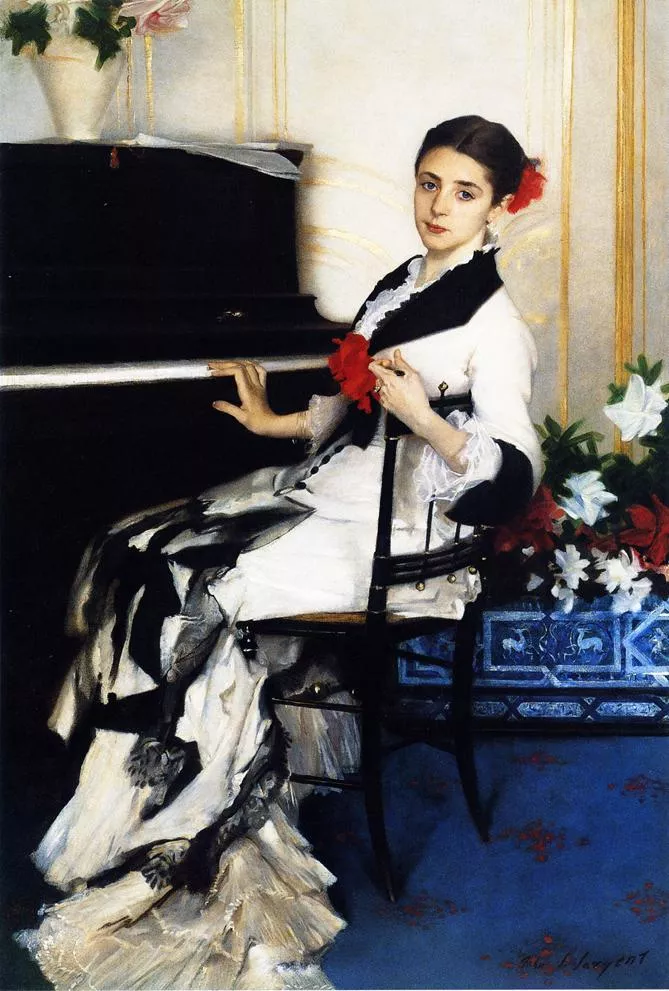 Sargent used a similar approach to pale skin in other portraits from the same period. The technique was not a one-off.
Why a Print Loses the Pallor
The trick of Madame X depends on layering. Sargent built the skin in thin, semi-transparent films, some of them so thin that the canvas ground is still visible underneath. A digital print cannot reproduce this. It lays pigment in an even layer across the entire image, and the black dress and the pale skin print with the same ink density. The lavender greys in the face turn into flat, slightly dirty cool tones. The translucency is gone, and with it, the reason the painting works.
A hand-painted oil reproduction is built the same way Sargent built the original. Ground first. Then the black gown in a single dense passage, because the dress was painted quickly and the paint is heavy. Then the skin, in thin layers, allowed to dry between passes. Then the diamond tips of the strap and the earrings, set on last, catching light the way the originals catch light. The result is not a picture of Madame X. It is a canvas that behaves the way the original behaves, one layer at a time.
Sargent himself thought the painting was worth keeping. When the Met bought it in 1916, he wrote to a friend: "I suppose it is the best thing I have done". He had spent three decades not showing it to anyone. He sold it, finally, on the condition that it stay out of sight for a year. It is now one of the most visited paintings in the museum.
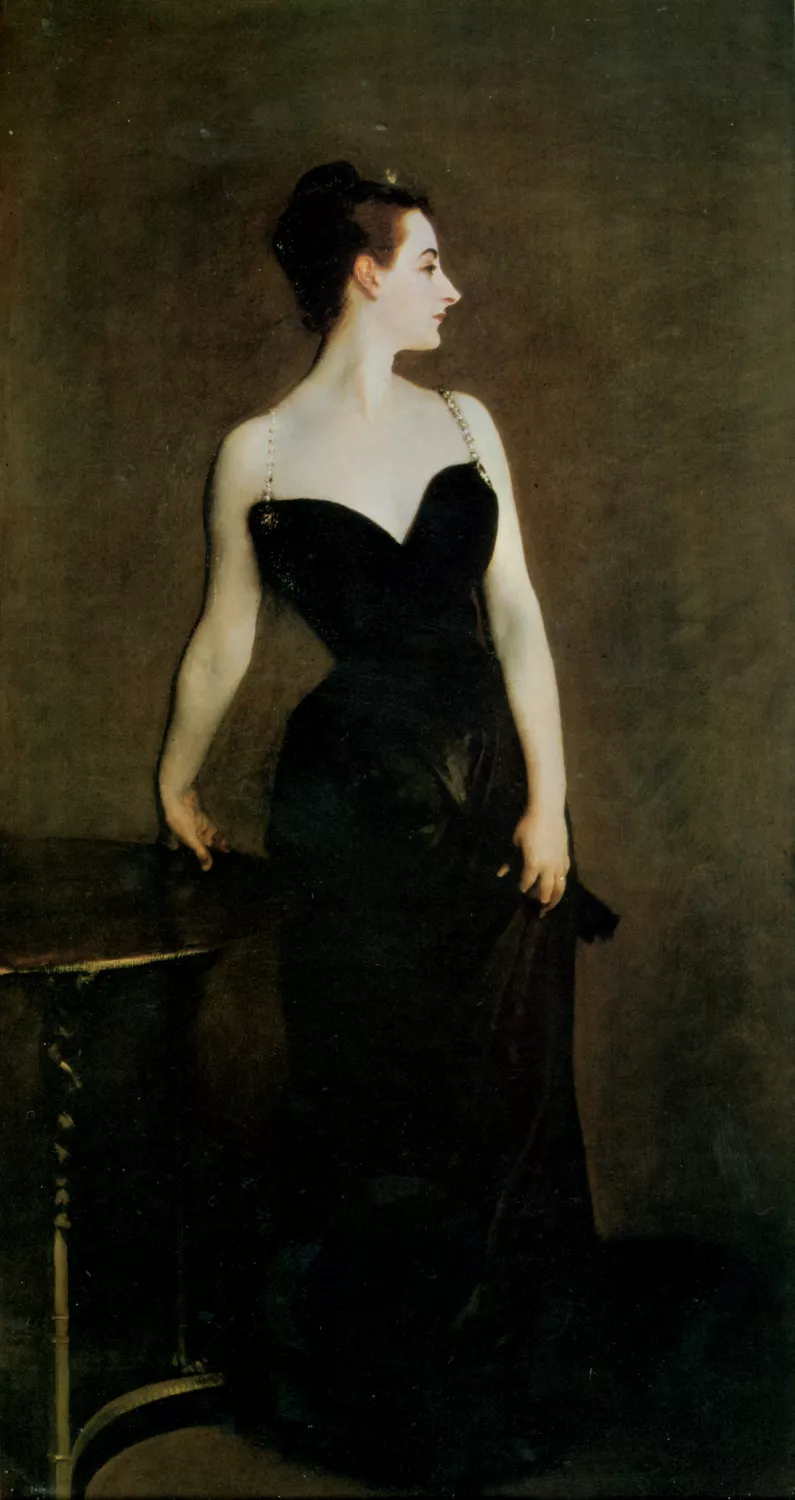 The painting as it hangs today at the Metropolitan Museum of Art. The strap sits on the shoulder, not off it. The scandal version exists only in secondhand accounts.
What to Look For
If you stand in front of the painting, start at the ear. Then the edge of the jaw. Then the shoulder, where the strap sits now. The whole architecture of the portrait leads to that one piece of black velvet lying on pale skin. Everything else in the painting is quiet so that this can work.
Then step back, and the face turns away from you, toward something on the other side of the room. The woman in the painting is looking at someone. It is not the viewer. That is part of what made Paris uncomfortable in 1884, and it is part of what makes the painting hold its ground today.
See Madame X as a hand-painted oil reproduction at oilpaintings.com. The pale skin is built in thin layers, the way Sargent built it, and the strap is set on last, in oil on canvas. View the painting
Images: Wikimedia Commons (public domain).